A total of 83.1 million cu m/d has been booked at the Velke Kapusany exit point for March delivery, complimenting the 2019 Russia-Ukraine transport accord.
Successful bidders for capacity are typically not made public.
Bookings for January delivery made by Russia's state-owned Gazprom Export were publicly confirmed by GTSOU CEO Sergiy Makogon.
The single-sided booking of unbundled capacity commenced when an onshore pipeline infrastructure linking Hungary to volumes originating from the TurkStream gas pipeline was commissioned in December.
This implied Gazprom had spare entry capacity to use on its Ukrainian border that it wouldn't utilize for Hungarian deliveries, according to sources.
The 2019 accord prescribes for 110 million cu m/d of entry capacity across the Sudzha and Sokhranovka interconnections bordering Russia.
RBP also reported successful sales for Isaccea exit into Romania to the tune of 4.7 million cu m/d, a Budince entry allocation of 1.714 million cu m/d, and sales at Hungary's VIP Bereg of 1.522 million cu m/d for import purposes.
GTSOU has also sold capacity rights for supply to Moldova, a landlocked country which recently signed a long-term supply agreement with Gazprom.
Moldova has been dependent on Ukrainian gas capacity for supply.
No capacity was sold on the Yamal pipeline for the 2nd consecutive month across the RBP and GSA platforms.
Exports from Russia to Germany via Yamal have been absent since late December.
Critics of Russia's Yamal strategy have argued that the lack of bookings on the route are designed to apply pressure on European authorities to approve the Nord Stream 2 pipeline system.
Some sources have said that the Nord Stream 2 pipeline is meant to bypass Ukraine.
Gazprom has repeatedly said that Nord Stream 2 is an economic project, and that it continues to meet its customer's contractual requests in full.
Russian purchases
Velke Kapusany exports started February at maximum capacity, but the throughput has averaged 47.637 million cu m/d since, taking another step-down Feb. 10, according to Slovakian TSO Eu Stream.
The Slovakian network has also not reported any additional capacity bookings for Velke Kapusany entry beyond the established long-term transportation bookings, which include the rights for Gazprom Export.
This effectively confirms Russian purchases, sources said, although storage players active in Ukraine booking the Velke Kapusany exit rights cannot be completely ruled out.
Ukraine saw developments in gas delivery to Poland that is also covered under the 2019 accord.
Ukrainian exit to Poland was effectively absent for much of 2nd-half January, but it restored Feb. 1 to an average flow of 7.25 million cu m/d, data from S&P Global Platts Analytics showed.
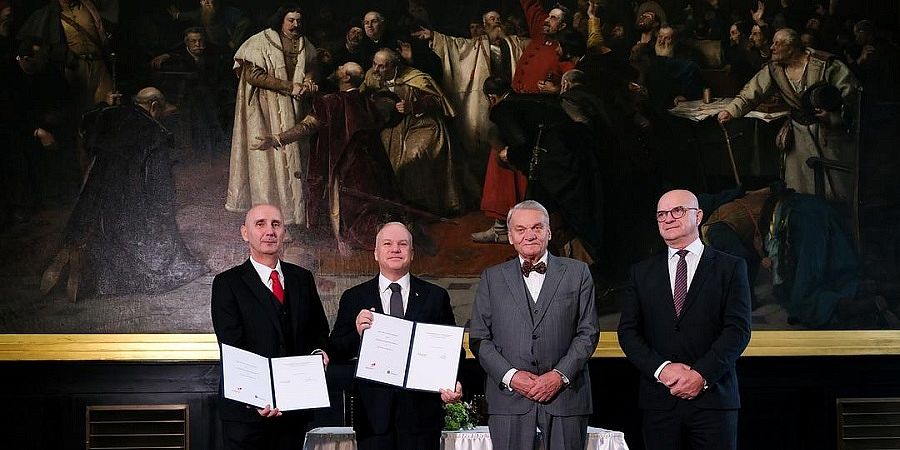
The accord was eventually signed in December 2019 amid presidential involvement and following a net payment of $2.6 billion as part of a long-standing arbitration award between Gazprom and Ukraine's state owned Naftogaz Ukrainiy.
GTSOU became fully independent from Naftogaz Ukrainiy Jan. 1, 2020, in accordance with the European regulation as part of Europe's Energy Community.
A shell holding company, Mahistralni Gazoprovody Ukrainiy (MGU), owned by the Ukrainian Ministry of Finance, was established to ensure GTSOU's independence.