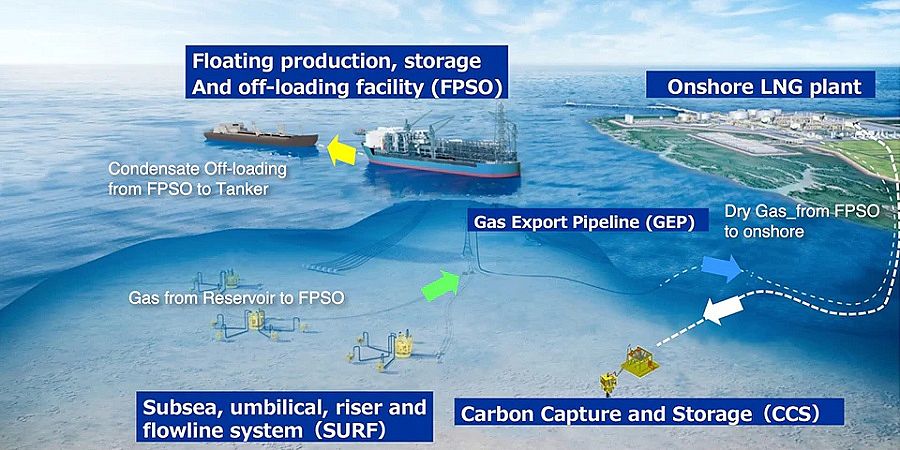
The Atapu field has been producing since 2020 through the P-70 Floating Production Storage and Offloading (FPSO) unit, with a production capacity of 150,000 barrels of oil per day (bopd).
The second development phase, Atapu-2, will comprise a new-built FPSO of 225,000 bopd capacity.
TotalEnergies owns an interest of 15% in the Atapu field, in partnership with Petrobras (65.7%, operator), Shell (16.7%), Petrogal (1.7%) and PPSA (0.9%).
The Sépia field has been producing since 2021 through the Carioca FPSO unit, with a production capacity of 180,000 bopd.
The second development phase, Sépia-2, will also comprise a new-built FPSO of 225,000 bopd capacity.
TotalEnergies owns an interest of 16.9% in the Sépia field, in partnership with Petrobras (55.3%, operator), Petronas (12.7%), QatarEnergy (12.7%) and Petrogal (2.4%).
The two FPSOs are expected to start producing as from 2029.
They have been designed to minimize greenhouse gas emissions through an all-electric configuration and technologies such as waste heat recovery, closed flare, cargo oil tank gas recovery and variable speed drive for compressors and pumps.
- the decision to launch Sépia-2 and Atapu-2 is a new milestone in our strong growth story in Brazil, a core area for the Company thanks to its world-class low-emission and low-cost oil resources
- following the startup of Mero-2 in late 2023 and the upcoming startups of Mero-3 in 2024 and Mero-4 in 2025, Brazil will soon account for more than 200,000 barrels of oil equivalent per day (boepd) in equity production for the Company;
- at their plateau Sépia-2 and Atapu-2, the tenth and eleventh FPSO for TotalEnergies in Brazil, will contribute to maintain TotalEnergies production in this key country above 200,000 boepd.